Back to Blog
Sales

How to Follow Up on Quotes Without Being Annoying

Most trades businesses either never follow up or follow up once and give up. Here's a proven system for following up on quotes that gets responses without burning relationships.

Buzz Brady··6 min read

You sent the quote. The client went quiet. Now what?

This is where most trades businesses fall apart. Some never follow up at all — they figure if the client wanted the job, they'd have called back. Others send one follow-up, get nothing, and give up. A small number follow up systematically and consistently win jobs their competitors thought were dead.

The difference between those outcomes isn't luck. It's process.

Why Quotes Go Quiet

Before building a follow-up system, it helps to understand why clients go quiet in the first place. The reasons are usually not what you think:

They're not ready yet. The job is real, but they're waiting on something — a partner's approval, another quote, a finance decision. They haven't forgotten you.

Your quote got buried. Email inboxes are chaotic. Your beautifully crafted quote got pushed down by 40 other emails within 24 hours of arriving. They fully intended to get back to you.

They're embarrassed to say no. Some clients go quiet because they've decided to go with someone else but don't want to have that conversation. A gentle follow-up actually gives them a graceful exit.

They have questions but didn't ask. Something in the quote confused them, they meant to ask about it, and then life got busy. Your follow-up prompts them to finally ask.

Understanding this shapes your follow-up approach. You're not being pushy — you're being helpful. Most of the time, following up genuinely serves the client.

The Follow-Up Timeline

Different jobs warrant different urgency, but here's a framework that works for most trade businesses:

Day 2–3: First follow-up. Send a short message checking that the quote arrived and asking if they have any questions. This isn't a sales pitch — it's a service touchpoint. Keep it brief.

Day 7–10: Second follow-up. If no response, follow up again. This one can be slightly more substantive — acknowledge that they're probably busy, reiterate your availability, and mention any urgency if genuine (your schedule for their preferred timeframe is filling up, for example).

Day 21: Third follow-up. This is the final systematic follow-up. Keep it light. Something like "I wanted to check in one last time before I archive this quote — are you still interested in getting this work done, or has the situation changed?" This gives them a genuine out and you a clean close.

Day 45+: Occasional check-in. If the job is high-value, a low-key check-in every 4–6 weeks can occasionally revive dead leads. Keep it very brief and conversational, not a formal quote reminder.

Channel Selection: Email vs. Call vs. Text

Email is your primary channel for most follow-ups. It's low-pressure, creates a paper trail, and gives clients a chance to respond when they have time. For Day 2–3 and Day 21 follow-ups, email is usually best.

Phone calls are appropriate for higher-value jobs or when email follow-ups have gotten zero response. A brief, friendly call — "I just wanted to check you'd received the quote and see if you had any questions" — can break through where email doesn't. Don't leave long voicemails.

SMS/text works surprisingly well for trades businesses, particularly if you've had previous conversations by text. Keep it casual and brief. Something like "Hey [Name], just checking if you had a chance to look at the quote I sent? Happy to chat through any questions." It feels personal without being intrusive.

Don't use multiple channels simultaneously. Pick one for each follow-up. Using email and calling and texting at the same time feels like pressure.

What to Actually Say

Most follow-up messages fail because they're either too long or too salesy. Here's what works:

Keep it short. Three sentences is enough for most follow-up messages. Clients don't need a sales pitch — they've already seen your quote. They need a reminder and an easy path to respond.

Make it about them, not you. "I wanted to follow up" is about you. "I wanted to make sure you had everything you needed" is about them. Small difference, big shift in tone.

Give them an easy way to respond. "Do you have any questions?" or "Would a quick call help?" gives them a low-friction action. "I'd love to schedule a time to discuss" feels like work.

Be honest about urgency. If your schedule genuinely has a constraint — you're booking up for next month, or prices are about to go up — say so. If you're making it up, don't. Clients can tell, and fake urgency erodes trust.

Never apologise for following up. "Sorry to bother you again" signals that you feel your follow-up is an imposition. It isn't. You're doing your job. Be friendly but confident.

Example Messages

Day 2–3 email:

Hi [Name], just checking in to make sure the quote came through okay. Let me know if you have any questions or if there's anything you'd like me to adjust. Happy to chat through it if that's easier.

Day 7–10 email:

Hi [Name], hope you're well. I wanted to follow up on the quote I sent last week — I know things get busy. Our schedule for [month] is starting to fill up, so I wanted to check if you're still keen to get this sorted. Happy to talk through anything.

Day 21 email:

Hi [Name], I'll keep this short — I'm following up one last time before I close out this quote. If the timing isn't right or you've decided to go a different direction, totally fine — just let me know and I'll get out of your hair. If you're still interested, I'd love to get this booked in.

Making It Systematic

The reason most trades businesses don't follow up consistently isn't laziness — it's that manual follow-up is easy to forget and time-consuming to track. When you've got 15 open quotes, remembering exactly where each one is in the timeline and who needs a follow-up today is genuinely difficult.

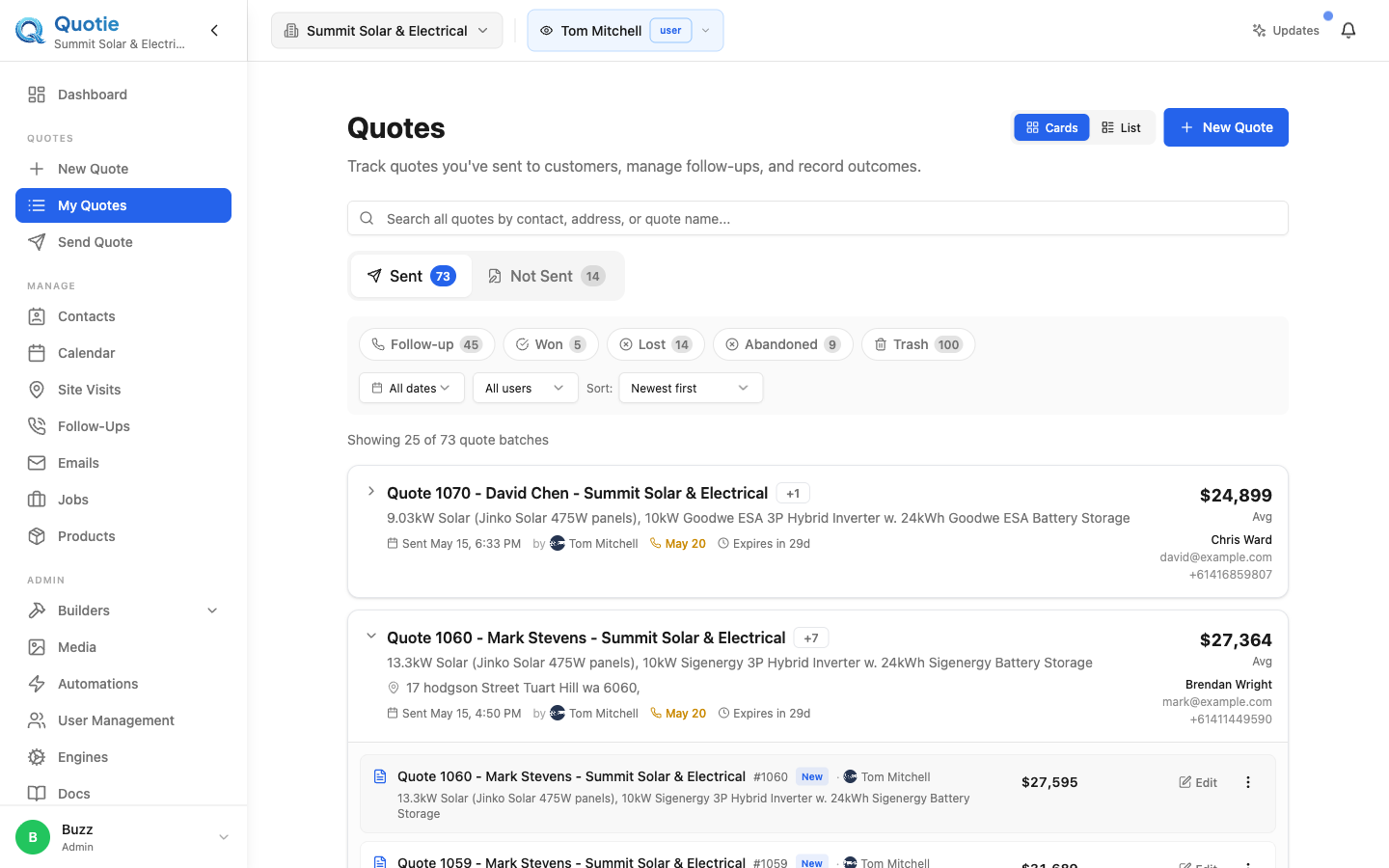
The solution is a system that does the tracking for you. Your quoting software should show you which quotes are approaching their follow-up window, flag ones that have been viewed multiple times (a strong buying signal), and ideally send initial follow-up messages automatically so you don't have to remember to do it.

With that infrastructure in place, your job is just to handle the replies — not to manage the schedule.

See how Quotie's follow-up tracking works.

Ready to quote faster?

See how Quotie helps trades businesses build and send professional proposals in under 30 seconds.