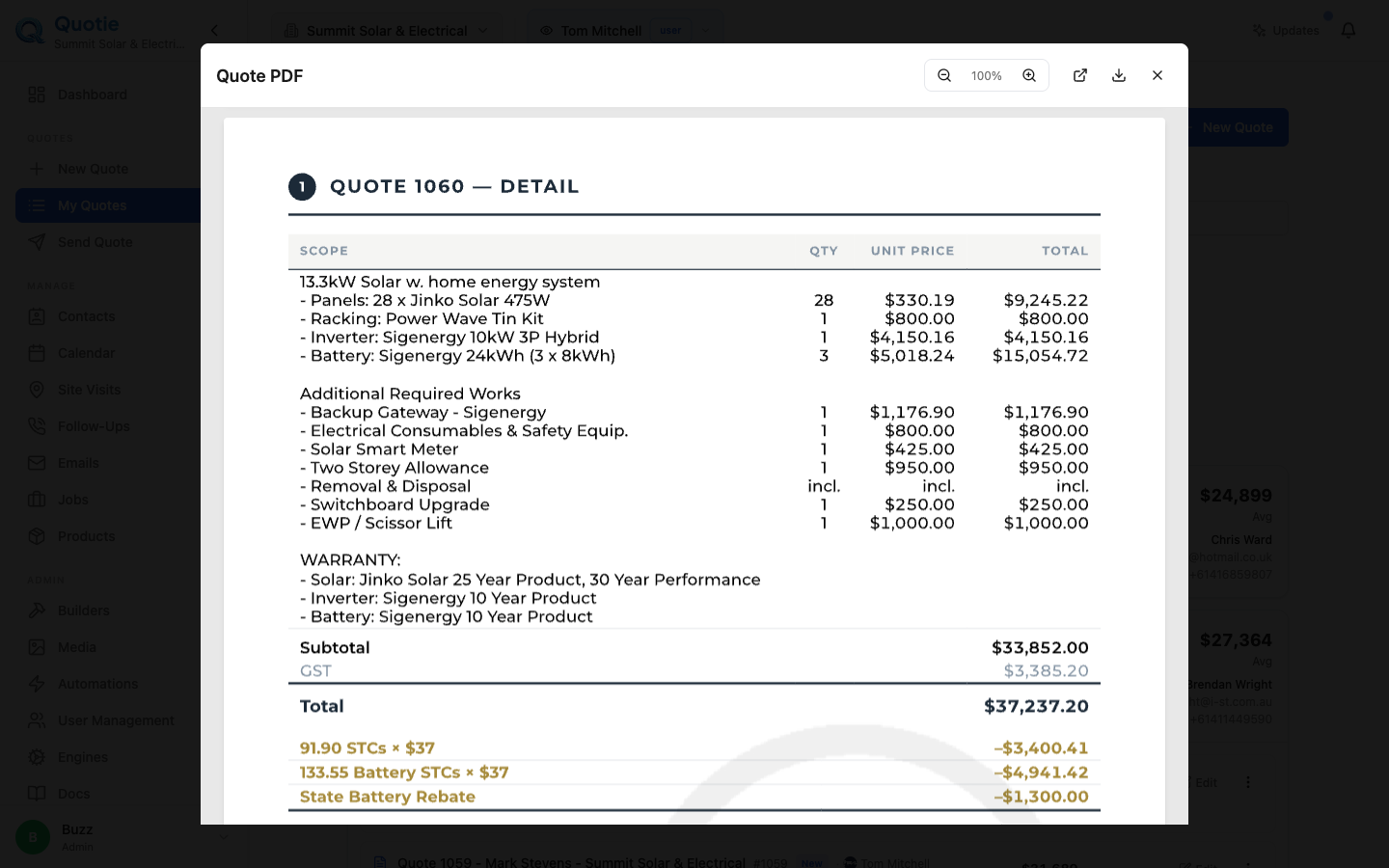
When you send a single-price quote, you're asking the customer for a yes or no. When you send multiple options, you're asking them to pick one. That's a fundamentally different decision, and a much easier one to say yes to.
Trades businesses that use multi-option proposals consistently report higher close rates and higher average job values. It's not a gimmick. It's how buying decisions work.
Why It Works
A single quote creates a binary decision. $12,000, take it or leave it. The customer compares that number to the other quote they got and picks the cheaper one.
Multiple options shift the frame. Instead of comparing your $12,000 quote to nothing, they're comparing your $10,000, $12,000, and $15,000 options to each other. They anchor to the middle. They ask "is the upgrade worth it?" instead of "is this worth it at all?"
Studies in home services show 20-40% higher close rates when prospects see tiered options versus a single price.
The Good-Better-Best Framework
Three tiers works best for most trades:
Good (entry-level). Budget-conscious customers. Covers the job at minimum viable quality. Compliant, functional, honest. Nothing you'd be embarrassed to sell, but stripped back.
Better (standard). Your bread-and-butter. What you'd recommend to most customers. Position it as "most popular" or "recommended."
Best (premium). Top-shelf materials, longest warranty, the extras. Some customers will always choose this. Give them the option so you don't leave money on the table.
Each tier needs to feel meaningfully different. The jump from Good to Better shouldn't be "slightly better cable." It should be "full surge protection and a 3-year labour warranty."
Pricing the Tiers
A rough structure: Good at 70% of your standard price, Better at 100%, Best at 140%. Not fixed rules, but it creates a range that feels fair.
Don't be scared of the Better-to-Best gap. If Best costs $2,000 more but includes a 10-year warranty and premium hardware, there's a customer for whom that's an obvious yes.
How to Present Them
Side by side, not one after another. A table or card layout where all three options are visible at once makes comparison natural. Don't make the customer scroll through three separate descriptions.
Clearly labelled. Names (not just "Option 1, 2, 3"), prices, and a brief summary of what's different.
Highlight the middle. Mark your Better option as "Recommended" or "Most Popular." This anchors most customers there, and they decide whether to step down or up.
The Hidden Benefit
Multi-option proposals make upselling natural instead of pushy. When the customer asks about the difference between Better and Best, that's not a sales pitch. It's a helpful conversation. They're already engaged, already interested in upgrading. You just explain the value.
Compare that to a single-quote scenario where adding anything feels like an upsell, because it is one.
The Execution Problem (Solved)
The barrier has always been time. Building one detailed quote is bad enough. Building three feels impossible.
The fix is a quoting system where your pricing and tiers are pre-built. Set up your three packages once. The system generates all options simultaneously. A three-option proposal takes the same time as a single quote.
Three ways to say yes instead of one.