Speed matters. The business that gets the quote out first often gets the job.
But accuracy matters more. A fast quote with an error is worse than a slow quote that's right. Because the customer might accept the wrong one, and now you're locked into a price that doesn't work, or having an awkward conversation about why the invoice doesn't match the proposal.
Where the Expensive Errors Come From
Most people think of quoting errors as typos or bad maths. Those happen, but they're not the costly ones. The real damage comes from structural mistakes:
Incompatible products. In solar, not every battery works with every inverter. Phase type matters. Some brands only support their own ecosystem. If your team has to remember which products go together, eventually someone quotes a system that can't actually be installed.
Wrong rebate calculations. Certificate values change. Eligibility depends on system specs. A rebate that was right three months ago might be wrong today. When the customer accepted expecting a $4,000 rebate that's actually $2,800, somebody has to wear the difference.
Missing conditional items. Two-storey access equipment. Wall brackets for certain battery brands. Removal of an existing system. When these items live in someone's head instead of the system, they get missed and come straight out of your margin.
Outdated pricing. Supplier costs move quarterly. If your quotes pull from a price list that hasn't been updated, a 5% increase you didn't capture on a $20,000 job is $1,000 out of pocket.
Spreadsheets Are Part of the Problem
Spreadsheets are flexible, which is exactly the issue. They'll let you enter anything into any cell. There's no guardrail that says "this battery doesn't work with that inverter" or "this rebate doesn't apply to systems under 10kWh."
You can build validation into spreadsheets. Some businesses have incredibly sophisticated ones that took years to build. But they're fragile. One accidental edit to a formula, one row inserted in the wrong place, and it breaks silently. You don't find out until a customer calls.
How Product Rules Fix This
The fix is encoding your business rules into the quoting system as hard constraints, not suggestions.
When a salesperson selects an inverter brand, the battery dropdown only shows compatible models. They can't select something that doesn't work. When they select single-phase power, three-phase-only products disappear. When they pick a specific battery brand, any brand-specific requirements appear automatically.
Rebates calculate from the actual system specs. Pricing pulls from a catalogue that gets updated once, in one place.
None of this requires anyone to remember anything. The rules are built in once and enforced on every quote.
Small Errors Compound
A $200 pricing mistake here, a missing $150 line item there. On their own, they seem small.
But if one in five quotes has a $300 error in the customer's favour, and you close half your quotes, that's a $300 hit on 10% of your jobs. On 200 jobs a year, you're giving away $6,000 in margin without even realising it.
Then there's the reputation side. When a customer spots an error on their quote, they start wondering what else is wrong. Even if they still accept it, they'll be watching every step of the job more carefully.
What This Looks Like With Quotie
During onboarding, we build your full product catalogue with current pricing and compatibility rules. Your business logic gets wired in: which products work together, which rebates apply, which conditional items appear for which scenarios.
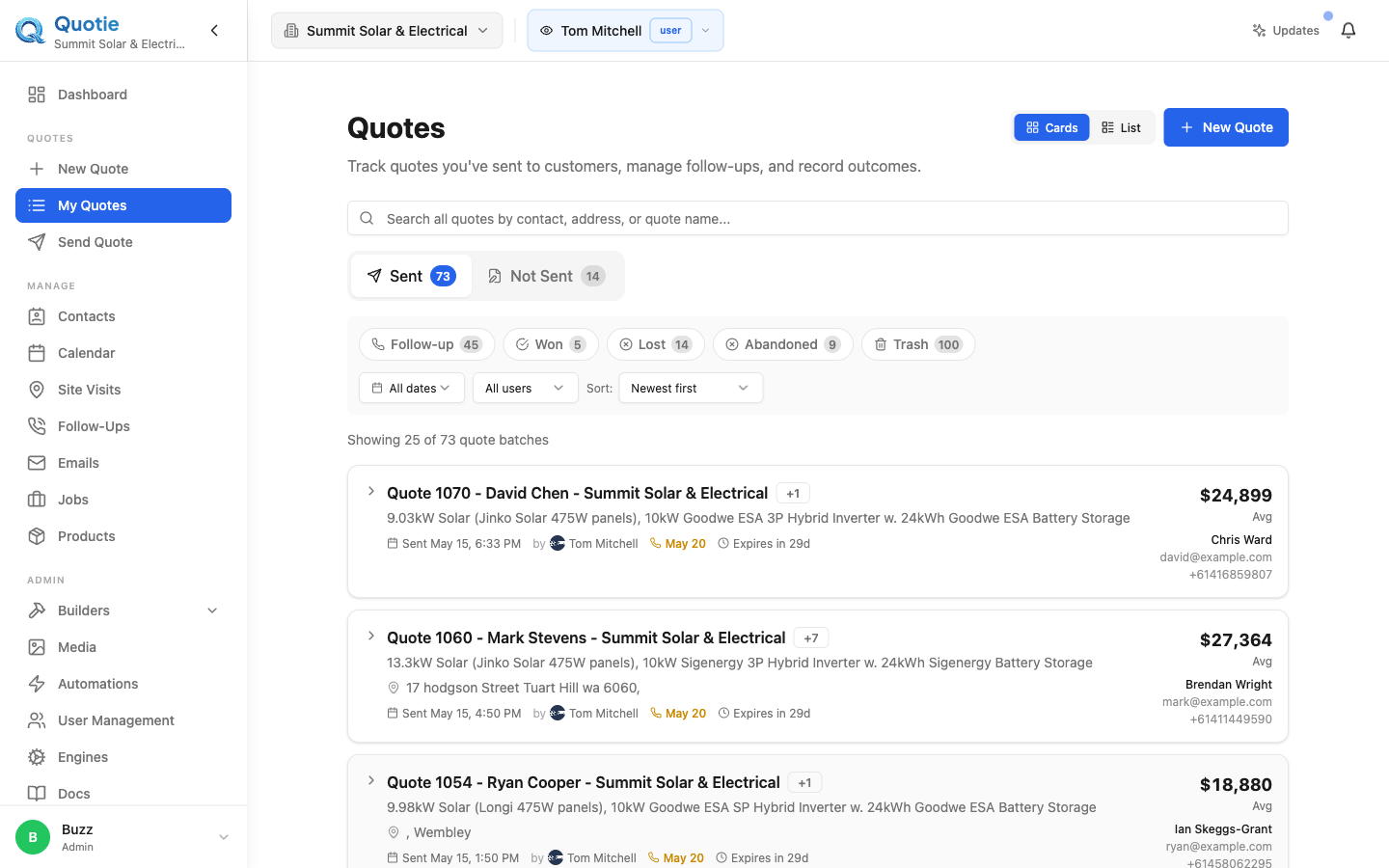
Your team opens the form, makes their selections, and the form adapts. Only relevant options show. Pricing calculates from your current catalogue. When they hit generate, the quote is accurate by design.
No compatibility charts. No price list lookups. No "let me check with the boss."